
Update, October 2026The efficiency story this piece predicted has largely played out. In 2025 Google put a typical Gemini text prompt at about 0.24 Wh, and OpenAI’s Sam Altman put an average ChatGPT query at about 0.34 Wh, roughly a tenth of the early estimate used below. Yet the data-centre build-out didn’t slow: Stargate went ahead with multiple US sites. Cheaper AI per question has meant far more questions. That’s the classic efficiency paradox, and it’s still the bit investors should watch. I’ve also corrected my original kettle comparisons, which overstated the energy per query.
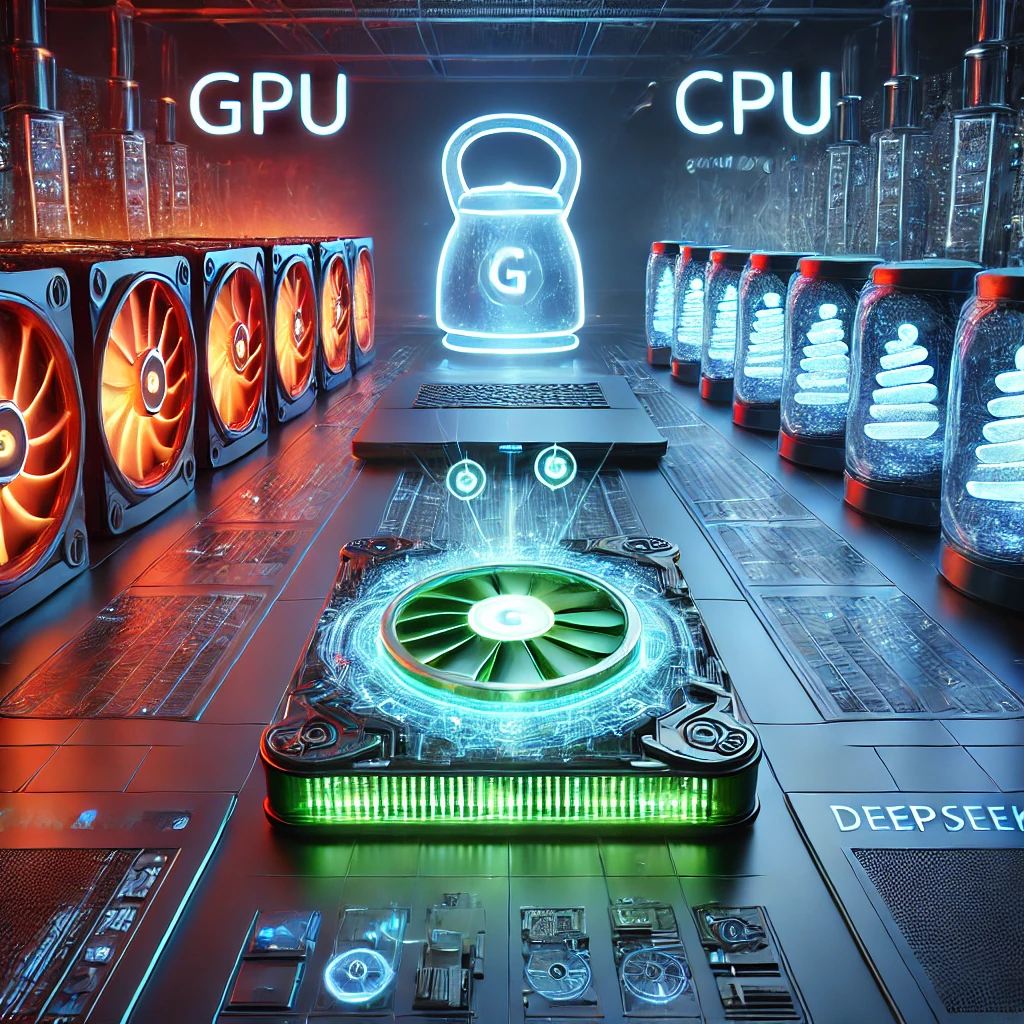
The belief behind billions of AI investment is simple: more computing power means better AI. DeepSeek, a highly efficient model from Chinese researchers, challenged that. Could this be an Emperor’s New Clothes moment for AI? Let’s break it down.
~1/300of a kettle per Google search
~1/35of a kettle per AI query (early estimate)
17%NVIDIA’s one-day share price fall
01The energy demands of traditional AI
Traditional AI models, such as OpenAI’s GPT-4, need substantial computing resources:
- High energy consumption: early estimates put each ChatGPT query at around 0.0029 kWh, nearly ten times a standard Google search at around 0.0003 kWh (Goldman Sachs). Boiling a full kettle takes roughly 0.1 kWh, so that’s about 1/35 of a kettle per AI query against about 1/300 per search.
- Infrastructure: these demands need massive data centres with thousands of high-performance GPUs, driving up costs and environmental impact.
02DeepSeek: a shift in AI efficiency
- Optimised performance: streamlined algorithms let DeepSeek achieve results comparable to larger models with far less computing power.
- Reduced energy use: exact figures are proprietary, but early estimates suggested 10-35x less energy per query, closer to a Google search than a traditional AI query.
03What it meant for big tech investments
- NVIDIA: the leading supplier of AI chips saw a 17% drop in its share price after DeepSeek’s announcement, on fears that demand for high-end GPUs could fall (Barron’s).
- Energy providers: Vistra, Constellation Energy and Talen Energy, which power data centres, saw share price falls of more than 20%.
- Stargate: the US-backed $500 billion Stargate Project assumes infrastructure-heavy AI will remain the standard. DeepSeek suggested that assumption may not hold.
04The Emperor’s New Clothes
- Questioning assumptions: the belief that better AI needs immense power and energy is being challenged. Are existing models over-engineered?
- Strategic shifts: companies may need to pivot to more efficient models, reducing demand for expansive data centres and high-end hardware.
05The accelerating pace of AI
- Innovation: a focus on efficiency opens new avenues for AI that is both powerful and sustainable.
- Accessibility: models like DeepSeek bring AI to a wider range of people and organisations, lowering barriers to entry.
06Energy use in everyday terms
How each compares with boiling a full kettle (about 0.1 kWh):
| Google search | Traditional AI (early est.) | DeepSeek (est.) | Bitcoin (exchange) | |
|---|---|---|---|---|
| Energy per query | ~0.0003 kWh | ~0.0029 kWh | ~0.0001-0.0003 kWh | ~0.01 kWh |
| Share of a kettle | ~1/300 | ~1/35 | ~1/1000 to 1/300 | ~1/10 |
07Don’t underestimate AI’s speed
- Efficiency over power: we can achieve more with less energy and computing.
- Global accessibility: lower costs bring AI to individuals, small businesses and regions without advanced infrastructure.
- Sustainability: lower energy per query means a smaller footprint per task, provided total use doesn’t simply balloon.
DeepSeek is a catalyst for re-evaluating where AI is heading. Efficiency doesn’t just save resources. It democratises AI, making it more accessible and more sustainable.
References
Goldman Sachs on AI and energy demand
Barron’s on AI’s impact on energy stocks
Cambridge Bitcoin Electricity Consumption Index
MIT Technology Review on Google’s Gemini energy figures (2025)
Energy figures are published estimates and vary with implementation and hardware.
Goldman Sachs on AI and energy demand
Barron’s on AI’s impact on energy stocks
Cambridge Bitcoin Electricity Consumption Index
MIT Technology Review on Google’s Gemini energy figures (2025)
Energy figures are published estimates and vary with implementation and hardware.
